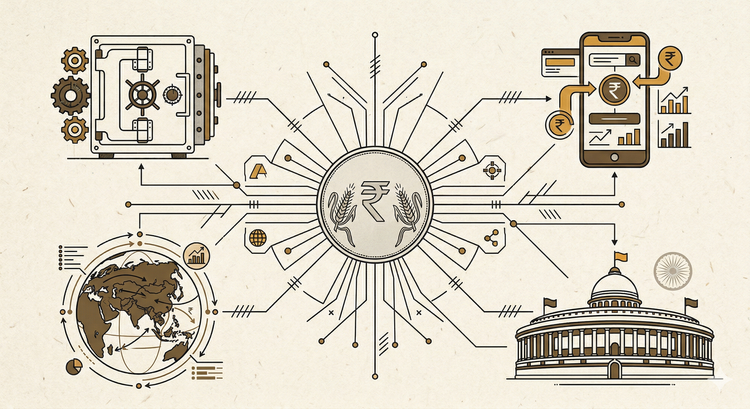
The bank created your loan from nothing and collected real money as interest

There are moments when you sit back and think about something long enough that it stops making sense — and then, if you keep going, it starts making a different kind of sense. The fiat currency system is one of those things. The stock market is another. Both should be on the list of man-made wonders. Not the comfortable list, with bridges and telescopes. The other list. The one with things that should not work but do, held together entirely by collective agreement and institutional inertia.
I have been sitting with this for a while. This article is me thinking out loud.
This should be counted among the wonders of the world
The pyramids took hundreds of thousands of workers and decades to build. The internet required decades of research, billions in infrastructure, and global coordination. Both are extraordinary. Both are tangible.
Fiat currency required none of that. It required a government to say: this piece of paper is worth something. And enough people to believe it. That is the entire construction. No quarried stone, no fibre optic cables. Just belief, enforced by law, sustained by habit.
The stock market is the same category of invention. A number on a screen represents your ownership stake in a company. That number moves because other people think it should move. Those movements create wealth — or the appearance of wealth — that can be borrowed against, taxed, inherited, and argued over in divorce proceedings. All of it rests on the collective agreement that the number means something.
I am not saying these systems are fraudulent. I am saying they are extraordinary. The audacity of building an entire global economy on layered abstractions — currency backed by trust, loans created from nothing, wealth measured in unrealized screen numbers — is something worth pausing on before we get back to checking our portfolios.
The system needs bodies
Here is something that took me a while to sit with: the debt engine requires participants. Lots of them. Continuously.
Every additional person is a potential borrower, a future taxpayer, a new participant in the debt cycle. Population growth is not just a demographic event — it is a macroeconomic input. This is why governments offer incentives for having children. Maternity benefits, tax breaks, housing schemes. The welfare framing is real, but beneath it lies this: the system needs the next generation of participants to function.
This is not cynicism. It is the honest mechanics of a debt-based economy. The engine does not idle. It requires fuel — in the form of people who will borrow, spend, work, and repay. Every generation enters the system and, knowingly or not, keeps it running.
Understanding this does not mean you should feel used. It means you should understand what you are participating in before deciding how to participate.
Business debt and personal debt are not the same thing
Nobody explained this to me clearly when I was younger, so I want to say it plainly here.
When a company takes on debt and cannot repay it, the company can be wound down. The liability, in most structures, stays with the entity. The founders walk away with damaged reputations and perhaps personal guarantees — but in principle, the debt belongs to the business, not the human.
When you take on personal debt — a home loan, a car loan, a personal credit line — the liability follows you. Your credit score. Your assets. Your future salary. There is no winding down a person. The obligation attaches to you and stays there.
The system was designed around entities. Limited liability companies exist precisely so that risk can be contained, capital can flow, and failures do not destroy individuals. But most ordinary people do not use entities. They borrow personally, sign personally, and carry the weight personally.
If you are going to take on debt — and in this economy, avoiding it entirely is nearly impossible — the structure of that debt matters enormously. Debt attached to a business that generates income is a tool. Debt attached to your personal identity, for a depreciating asset, is a weight.
Most people are handed a weight and told it is a tool.
If you opt out, you disappear
I want to try a thought experiment. Imagine you decide to opt out entirely. No loans, no credit cards, no investments, no participation in any financial system. Your savings sit in a locker at home. You work only for cash. You spend only what you have.
In one sense, this is the most financially conservative position possible. No debt, no exposure, no risk.
In another sense, you have become economically invisible. Your money sits still instead of being lent out and multiplied. No debt to service, no capital deployed, no GST generated, no activity showing up anywhere that the system can count. You are present but unaccounted for.
The system does not need you to be rich. It needs you to be in it.
I find this genuinely uncomfortable. There is something unsettling about a structure designed so that opting out feels irresponsible — not morally, but economically. As if participation is not a choice but a civic obligation.
I do not have a clean answer for that. I just think it is worth naming.
The stock market — numbers on a screen pledged as real collateral
Let me tell you what I do not fully understand about the stock market, and I say this as someone who thinks about systems for a living.
You buy shares in a company. The price goes up. On paper, you are wealthier. But you have not sold anything. You have not received anything. The number changed because other people think it should be higher — sentiment, a quarterly report, an algorithmic trigger, a fund manager's call on a Tuesday morning.
That number is unrealized. It is not money until you sell. And when you sell, you pay capital gains tax on the difference. So the wealth you have been told you are accumulating comes with a cost that only becomes visible at the exact moment you try to access it.
Here is the part that genuinely stops me: you can pledge those unrealized numbers as collateral for a real loan. You show a bank a screen with a number on it — a number that could change by 30% next week — and the bank gives you actual, spendable money against it.
Real cash. Borrowed against a fiction.
I am not saying this is wrong. I am saying it is extraordinary. The same collective belief that makes fiat currency work is operating here, one layer up. The stock price is real because enough people act as if it is real. The loan against it is real because the bank treats the collateral as stable. And the whole thing keeps moving because nobody stops to ask what happens when the belief wobbles.
Ideally, markets should be a zero-sum game. For every winner, a loser. But they are not, for one specific reason: the interest on the debt that funds market participation was never created. Somebody, somewhere in the chain, always ends up paying more than was ever put in. The system is not zero-sum. It is tilted — subtly, structurally, by design.
So should we get into debt and die?
This is the question I keep coming back to, and I am going to be honest: I do not have a satisfying answer.
The system is what it is. You can understand it clearly — the loans created from nothing, the interest extracted from real labor, the stock prices that are belief made visible, the debt engine that needs bodies to keep running — and still have to live inside it. Understanding does not exempt you.
I am at a crossroads that I think many people share, but few say out loud. On one hand, participating in the debt system feels like endorsing it. Taking a home loan means a bank typed money into existence, and I will spend twenty years paying it back with real earnings, real time, real life. That bothers me more now that I see it clearly.
On the other hand, opting out has costs too. The locker savings thought experiment is fine in theory and impractical in almost every real life. Most people have families, obligations, and futures they are trying to build. The system is the water. You can understand it, you can navigate it more carefully, but you cannot simply decide to stop being wet.
What I have landed on, for now, is this: participate consciously. Understand what kind of debt you are taking on and why. There is a real difference between a loan that builds something and a loan that signals something to a neighbour. The number in your portfolio is not money until it is — and the tax bill arrives at the exact moment you try to access it. The bank did not lend you anyone else's savings. It created your loan with a keystroke and will collect real interest from your real earnings for decades.
Hold all of that in your head, and then make your choices anyway. With open eyes.
The system will not change because you understand it. But you might.