The scoreboard nobody designed, but everyone plays

Nobody designed this game. There is no rulebook, no referee, no agreed finish line. And yet most people spend a large part of their lives playing it — comparing, signaling, keeping up, falling behind, starting over. This is not a piece about how to stop. I am not sure stopping is honest, or even possible. It is more of an attempt to name the thing clearly, because once you see it, you cannot fully unsee it.
Comparison is hardwired, not a character flaw
Start with this: everybody compares.
The person telling you they have stopped comparing is, at some level, comparing themselves to someone who compares more. It is not vanity. It is old wiring, running before your conscious mind gets a say.
For most of human history, reading social status accurately was a survival skill. Who has resources? Who is a threat? Who is worth allying with? The brain that tracked those signals lived. That instinct did not disappear when we moved into apartments and started scrolling feeds. It found new surfaces to run on.
So when you notice what your neighbor drives, or how your cousin's flat compares to yours, or how many people liked that photo, that is not weakness. That is the ancient circuitry doing exactly what it was built to do.
There is a word worth sitting with: perception. People care deeply about how they are perceived. What the relatives think. What the school gate crowd thinks. What do the colleagues think? Not every minute, but enough that perception quietly shapes decisions about houses, cars, schools, clothes, holidays, and what gets posted online.
We are emotional creatures first. The feelings arrive before the reasoning does. By the time the reasoning shows up, the decision is often already made.
Situations win more often than we admit
Here is the part most writing on comparison skips: sometimes you do not choose to play. The game finds you.
You have genuinely decided you do not care about keeping up. And then your child starts at a new school, and every other kid has a particular brand of bag. Or a younger sibling buys a flat, and the family WhatsApp group goes quiet in a specific way. Or you attend a colleague's housewarming and spend the drive home recalculating things you thought were settled.
Nobody forced you. And yet something shifted.
It is too easy to call that weakness. The honest answer is that sometimes situations win. Social pressure has real weight, and resisting it every single time comes at a cost not everyone can afford. The person who holds firm against every social expectation is either very grounded or very lonely — and it is not always obvious which.
Yes, you are not supposed to blame situations. But sometimes they win anyway.
This is not an excuse to give in to every pull. It is a reason to stop pretending the pull does not exist — and to stop judging yourself, or others, every time it does.
Show me the incentive, I'll show you the outcome
Charlie Munger had a line that explains most of human behavior in nine words:
"Show me the incentive, I'll show you the outcome."
The comparison game runs entirely on real incentives. Not imaginary ones.
The rewards are real. Drive a certain car, and people treat you differently. The right postcode changes how introductions go at parties. The right school opens certain doors. These are not things happening in your head. They are actual social currency, and the brain logs them accurately.
So people signal. Not because they are shallow, but because signaling works.
The car, the house, the party, the vacation, the follower count, the kid's school, the kid's toys — none of these are random vanities. Each one is a rational response to a real incentive in the social fabric around you. Nobody designed that fabric. It grew from millions of people responding to the same rewards over decades.
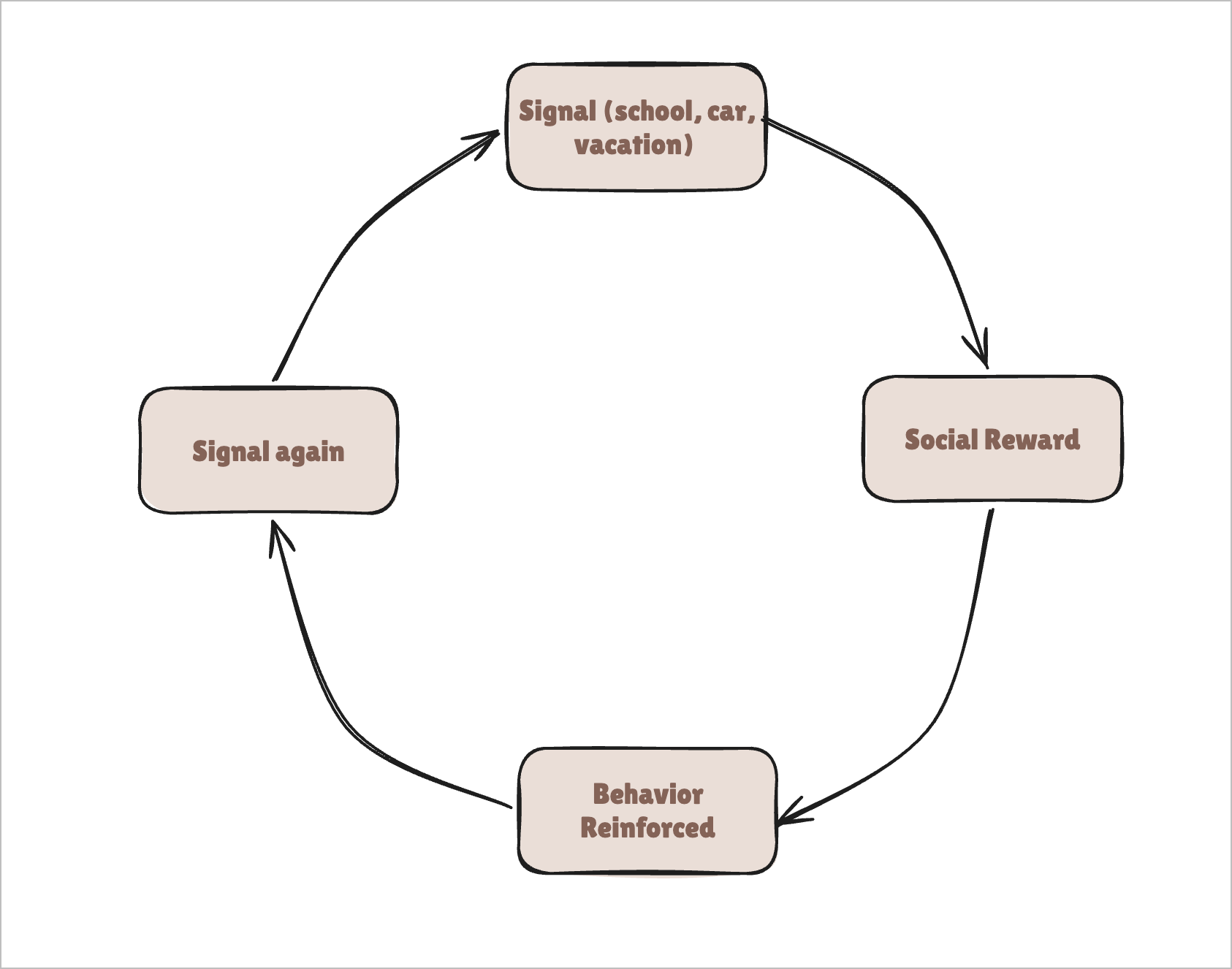
The scoreboard runs on those incentives. Stepping back from it is harder than it sounds because the game is not something outside you that can be rejected. It is part of how belonging works.
The game is the water. Most people do not know they are wet.
What happens when you question the basics
At some point, if you are paying attention, the question arrives. Why this car? Why this school? Why this party that costs more than it should and leaves everyone mildly exhausted?
When that question comes honestly, something shifts. Not completely, not all at once. But the scoreboard becomes visible in a way it was not before. And a visible game can be played differently from an invisible one.
This is what I think people actually mean when they talk about being intentional with money. Not budgets or investment strategies. Knowing the difference between what you want and what the scoreboard tells you to want. Those two things overlap a lot — but they are not the same, and quietly confusing them over many years gets expensive.
The school fees for the prestigious institution. The house in the neighborhood felt necessary. The car that replaced a perfectly functional one. Add those up across a decade, and the scoreboard has extracted a real sum. Nobody held a gun. The incentives just did their quiet work, and nobody stopped to name them.
Questioning the basics is not enlightenment. It is just clarity. And clarity, it turns out, is worth something.
You are still in the game, and that is fine
Let me be clear about what I am not saying. This is not a call to opt out of society, to stop caring what anyone thinks, or to pretend that houses, schools, and cars do not matter. Some of those things genuinely matter — for your children's futures, for your own comfort and peace of mind. The goal is not to perform indifference.
The goal, if there is one, is just to see the scoreboard.
Because once you see it — once you recognize that this game has no designer, no agreed-upon rules, no finish line, and no winner — the grip loosens a little. Situations will still win sometimes. You will still make decisions that were more about perception than preference. That is human. That is fine.
But there is a real difference between playing a game you can see and playing one you cannot. The first allows for choice. The second just happens to you.
The rupee you spent because you genuinely wanted to, and the rupee you spent because the scoreboard quietly demanded it — they look identical in your bank statement. Only you know which is which. And knowing that distinction, even imperfectly, is about as much freedom as most of us are going to get.
There is one more layer to this.
We have talked about the comparison game as if it runs on its own, sustained by social incentives and human wiring. But there is a larger system underneath it — one that creates the money everyone compares themselves to and collects real interest on loans it conjured out of nothing.
That deserves its own article.
Next: The bank created your loan from nothing and collected real money as interestcompares themselves to and collects real interest on loans it conjured out of